Posts from — January 2010
Haiti – “Unity Makes Strength”
Haiti appears to have had a lot more than its fair share of political turmoil, poverty and natural disasters over the years.
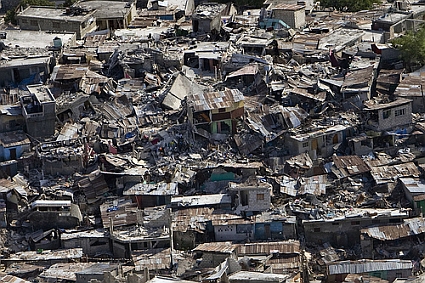
On Tuesday afternoon, January 12, 2010, Haiti’s history and life of its citizens was again abruptly turned upside down. The tiny island in the Caribbean Sea was struck by a magnitude-7.0 earthquake, the country’s most severe earthquake in more than 200 years.
The confirmed death toll has risen to 150,000+, but that was only the count of bodies so far found in Haiti’s capital, Port-au-Prince.
Haiti’s recorded (troubled) history began about 5 centuries ago, on December 5, 1492, when the European navigator, explorer and explorer Christopher Columbus landed on the beach of an island in the region of the western Atlantic Ocean, that later came to be known as the “Caribbean Sea.”
Haiti was inhabited by the “Taíno,” an Arawakan people, who variously called their island “Ayiti,” “Bohio,” or “Kiskeya.” Columbus promptly claimed the island for the Spanish Crown, and soon after his arrival renamed it “La Isla Española,” the Spanish Island.
Following these events, both Spain and France ended up colonizing what is now modern-day “Haiti.” Eventually, however, the island’s emerging multicultural population battled through and won its own independence about 2 centuries ago, in 1804.
Haiti’s Flag was adopted on February 25, 1987. The nation’s flag is a simple one with two horizontal strips of blue and red of equal size. The blue and red of the flag were retained after a French Tricolore was torn up in 1803, one year before Haiti’s independence. The two parts ended up being stitched together horizontally to make a completely new flag.

The flag of Haiti.
What Haiti’s Flag symbolizes and the feelings it evokes are what make this flag especially powerful. It recognizes the country’s European heritage through its vibrant blue and red colors.

The coat of arms of Haiti on the center of the flag.
Since 1843, Haiti’s Flag has had the coat of arms of Haiti on a white panel in the center. The coat of arms depicts a trophy of weapons ready to defend freedom, and a royal palm for independence. The palm is topped by the Cap of Liberty. The national motto is on a white scroll reading “L’Union Fait La Force,” Unity Makes Strength.
Today, Haiti’s left to deal with the tragic effects of a magnitude-7.0 earthquake that struck on January 12. Fortunately, many countries, organizations and individuals have come to Haiti’s aid.
People all over the world are showing a strong unified front by displaying Haiti’s Flag on their cars, in office windows, or outside their homes. By so doing, they also pay respect to the hosts of lives lost in this recent tragedy.
Visit the American Red Cross for information on donating money to Haiti.
January 25, 2010 No Comments
Monday was Martin Luther King Day
Many people have come and gone over the 1000’s of years we have been upon the earth. Few make their mark beyond being born, learn to be part of a family, work, marry, provide, enjoy life & retirement, grandchildren and then death. Every life is important and their contribution is immeasurable in histories large and continuing track. Every once in a while society is blessed or cursed with an individual who makes a difference for generations to come.
Martin Luther King is a man who strived to do good in a non-violent way to change the way the majority thought and acted. Behavior over a long period of time had been ingrained in a large part of society. Many wanted a separate but equal society, in the 60’s and for years before and some years after, it was separate, but not equal. On Monday, January 18th we celebrated Dr. King’s birth. In the early eighties the Congress approve and President Reagan signed the Martin Luther King holiday. Which some have called “Human Rights Day.”

Martin Luther King, Jr. - photograph taken in 1964.

Was Dr. King perfect, no, he was as human as the next individual; we have learned that he made the same mistakes as others who have had power put into their hands. But even with his personal faults he became the symbol of a people and a generation that strived for equality in treatment and behavior of all the people of the world.

President John F. Kennedy meets with Dr. Martin Luther King, Jr.

Martin Luther King's signature.
As Theodore Roosevelt said, he was a man in the arena, and he did not shirk from what he knew was right. Dr. King suffered verbal and physical attacks to him, his family and his co-workers. (Read the “I have a dream” speech) He was the youngest man to ever receive the Nobel Peace Prize; he worked with John Kennedy to move the rights of minorities forward, and in 1965 he stood over President Johnson as he signed the Voters Rights Act a measure that was one of his key accomplishments.

President Ronald Reagan signs Martin Luther King Holiday Bill.
Like all men who stand against the status quo, he paid the highest price with his life. In this upcoming week, remember those who have made a difference and fly the flag.
January 17, 2010 No Comments
Build It and They Will Come. Part I Design It
Ok, I know the saying is a bit trite and worn around the edges, but it still plays well in Hollywood. Remember ‘Field of Dreams’ where Kevin Costner builds a baseball field on his corn farm in the middle of Kansas…? So what’s the connection to your big monument project? Will they really come to see your monument or memorial once you get it built?
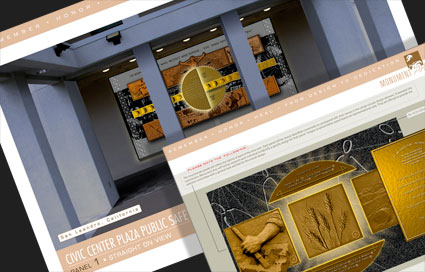
Designing your monument and planning the construction of your communities ‘once in a lifetime’ monument or memorial project can be a daunting undertaking. And it only gets more daunting once you actually roll up your sleeves and commence with the heavy lifting. So, my objective in today’s message is to walk you through the first step that can produce a successful outcome for your monument project, and maybe even get you some big kudo’s along the way. This issue will focus on Part I of “Build It – and They Will Come”, the Design. My next issue will focus on Part II, Construction…
First, design it.
Kevin Costner didn’t have to worry much about this one. All baseball diamonds and fields are the same. People don’t come to a ball game to view the design of the field, they come to view the action on the field. But your monument project is much different. People will come to your monument precisely because of the design. It will be the design that keeps them coming back time and again. I can’t overstate the importance of design enough.
All else flows from the design of your monument or memorial. Lets say that again with feeling; All else flows from the design of your monument or memorial! If the design stinks, if it is ‘boring’, or if it looks just like other monuments, your visitors will sharply dwindle over the years and you will be left with something that simply collects dust instead of inspiring future generations. And when you consider the cost of the project, which is always more than anyone had planned for, you want to make sure your visitors are motivated to return time and again, thus helping to justify the initial investment.
Design by committee is a receipt for disaster! Because the design issue is key to the overall success of your project, please do not leave this critical step to amateurs – and please do not assume that a room full of amateurs can somehow get inspired to come up with a design for the ages. It never happens that way. What ‘design by committee’ will get you is a bad design that everyone agrees on, sort of.
You know you and your committee are serious about your monument project. Perhaps it is honoring first responders, those police, firefighters and others who put their lives on the line every day to make your community safe. Or perhaps you are honoring your veterans and the service they provide to defend the virtues of preserving freedom. Or perhaps you are choosing to honor a community leader or other inspirational figure who has contributed much to the social fabric of your city… Whatever the purpose of your monument or memorial, you know you are serious about seeing that the end result is the very best it can be, and that it is timeless in both design and meaning.
To accomplish your objectives, you must retain a professional design firm. Period. They must be skilled in the many nuances of this line of work. They must strive for excellence both in design and fabrication. They must be experienced. How can you know if you’re dealing with a professional?
Professionals will spend a lot of time up front with you and your committee asking many questions. Professionals want to get inside of your thoughts and purpose for the project. Their questions will force you and the committee to really dig deep into the why’s of your project. If they don’t ask questions, send them packing.
I wish for you that your next monument project is a pleasant experience along the way, and has a successful outcome once you’re finished.
Onward & Upward…
January 13, 2010 No Comments