MANY VOICES, ONE FLAG

Posts from — May 2010

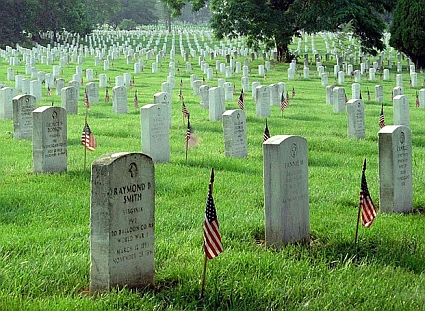
Memorial Day

It is a Jewish custom to place a pebble or small rock on a tombstone when visiting a grave.  One explanation is that Abraham placed a pile of rocks over the grave of his wife, Sarah.  Visitors to the grave would add a rock to the pile.  It was a way to say that they wanted to add to Sarah’s monument so that she would never be forgotten.

In the same way, we place small flags on the graves of those who sacrificed their lives defending our freedom.  When we display a flag on a fallen hero’s headstone, it is a way of saying.”  We decorate your monument, that your sacrifice will not be forgotten.”  Display of flags on Memorial Day has been expanded to include the graves of all veterans.   We do this to recognize their service to our country.

Memorial Day

On Memorial Day larger flags flown from flagpoles are lowered to half-staff during the morning.  This is done to collectively to honor all our war dead and deceased veterans.  When the U.S. flag is first raised in the morning, it is raised for an instant to the top of the pole.  It is then lowered to the half staff position.  At noon, the flag returns to the top of the pole.  It remains at full staff until the end of Memorial Day when it is lowered for the evening.

This centuries old custom began at sea.  Sailors lowered their ship’s ensign to half-mast as a sign of mourning.  The practice spread to land and is now a sign of mourning around the world.  Visit UtahFlagMan.BlogSpot.com for more information about flags flown at half-staff and at half-mast.

May 27, 2010   2 Comments

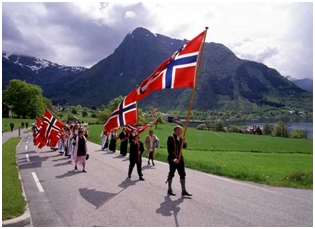
Syttende Mai

The Norwegian flag plays a central role on the celebration of Norway’s great national holiday.  Sometimes called the “Constitution Day” or the “National Day,” it is most often simply called “syttende mai,” Norwegian for May Seventeenth.

Syttende Mai

It celebrates the day in 1814 when Norway adopted its Constitution and declared its independence.   Sadly, the Norwegians were forced into an unwanted union with Sweden.  A symbol of the union appeared on their flag.  The Union device was an awkward design that combined the Swedish and Norwegian flags.  The Norwegians disliked the union emblem and said it looked like a bowl of herring salad.  They longed for the return of their “clean flag” with the union symbol removed.  They longed for their independence.  In 1905 the union of Sweden and Norway was finally dissolved.  Norwegians again had their “clean flag” without the herring salad.

Syttende Mai

The Norwegian flag with the union emblem (upper left).

To celebrate Norway and the Norwegian flag on Constitution Day, the people form huge parades all over the countryside.  The marchers each carry their national flag.  The parade is for the participants, the people who march in the parade.  It is not a parade for observers.  Parades are held in cities and towns over the length and width of Norway.  In Oslo alone, the national capital, one hundred thousand people take part in the celebration.  Many wear the national costume or the national colors of red, white and blue.  However, central to it all is Norway’s flag.

May 15, 2010   No Comments

The American Eagle

We see the American Bald Eagle on our coins, dollar bills, and the caps of our military officers.  It is perched as the top ornament or finial on flag staffs displaying the Stars and Stripes.  We recognize the bald eagle as our national emblem so readily that we may not even ask the obvious questions: why the eagle, where did it come from and what is its history?

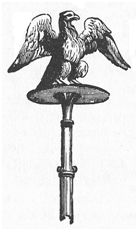
Having dominion over other birds of the air, the eagle became the symbol of power and authority in ancient times.  Both Greeks and Romans associated the eagle with their gods.  For the Roman Legions, the eagle developed into their Aquila, their Eagle Standard.  This tied the eagle, as a symbol, to the Roman Empire and empires that came after it.

Roman Eagle

The Roman Eagle.

Charlemagne selected the eagle to symbolize the Holy Roman Empire.  By the time of the American Revolution, the empires of continental Europe used the eagle as the symbol of empire.  The British did not use the eagle as a symbol of empire, but it was well established in the heraldry of continental Europe.  The Americans saw themselves as a new empire taking a place among the empires of the world.

In 1782, when congress adopted a national seal, it was logical that they should choose a symbol that recognized their new status as the American Empire.  Charles Thompson, the secretary of the Congress, suggested the eagle for the new Great Seal.  He had likely seen coins of European empires that depicted eagles with a shield on their breasts.  The Maria Theresa Thaller, a coin of the Austrian Empire first issued in 1780, is a good example of this.

Maria Theresa Thaller

The The Maria Theresa Thaller.

Although Congress considered several different designs for the new seal, they adopted a seal showing the American shield “on the breast of the American bald Eagle.”    This new American Empire, composed of thirteen free and independent states, had a Great Seal mirroring the seals of other empires.

Today, we don’t think in terms of empire as the Founding Fathers did.  That was an idea important in the eighteenth century.  Today, the idea of the American Republic is more important, a form of government where the power and authority of the nation is derived, not from a king or emperor, but from the people.  The word republic comes from a Latin phrase, res publica, which means “in the matter of the people.”    Royal proclamations began: “We, George III….”  However, our Constitution begins, “We the People….”

1782 Great Seal Design

The 1782 Great Seal Design.

When we look at a flag staff displaying the Stars and Stripes, we see a top ornament, the Eagle, which looks very much like the Aquila or Eagle Standard of the Roman Legions.  It reminds us of our birth as a nation.  We may not now consider our nation as an empire, but the American Republic has taken its place among the powers of the earth.

May 11, 2010   3 Comments