Posts from — June 2010
A Rare Flag Oddity
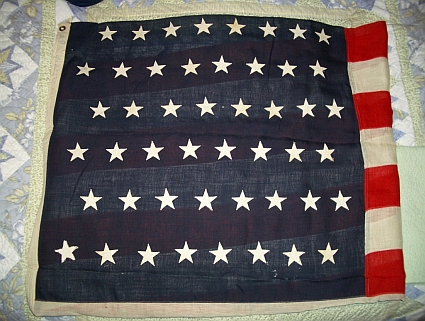
The second flag pictured below is a rare unofficial Forty-seven Star Flag that was converted into an unofficial variant Forty-eight Star flag. The flag maker produced the flag believing that either Arizona or New Mexico would enter the Union alone which would have created an official Forty-seven Star flag. Instead, both states entered the Union in the same year. The stars in the canton of U.S. flags increased from forty-six to forty-eight without an intervening Forty-seven Star Flag.

Union showing added forty-eighth star in lower left hand corner.

Union showing the original forty-seven stars without added star.
The manufacturer apparently also believed that the pattern for Forty-seven and perhaps an even later Forty-eight star flags would follow a staggered pattern of stars as seen on the forty-five and forty-six star flags. Perhaps the maker intended a flag that could be updated when the forty-eighth state would eventually enter the Union. If this was indeed the logic, the manufacturer was wrong on all counts.

Detail showing added crudely sewn forty-eighth star on the left.
A crudely appliquéd Forty-eighth star was added, but the pattern of stars was still incorrect making the flag a double oddity. There are few Forty-seven star flags in existence. This is perhaps the only Forty-seven—Forty-eight star flag.
While this flag’s design has never been official, it gives us insight into how the United States flag has evolved as new states joined the Union. If a fifty-first state joins the Union in the future, we can expect that flags will be made anticipating a new pattern of stars. Flag makers that guess wrongly will have unofficial variants that may one day be rare considered flag oddities.
June 29, 2010 2 Comments
The Star Spangled Banner
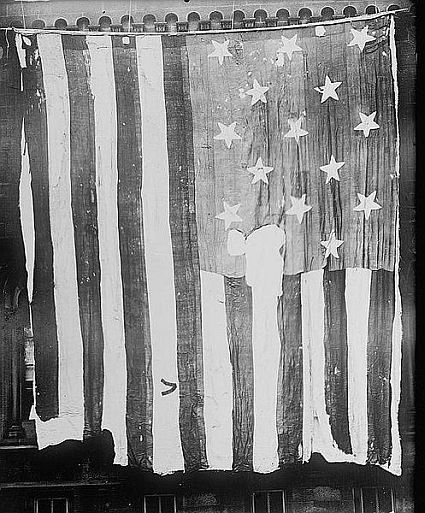
Between the years 1795 and 1818 is the only time when the U.S. flag had more than thirteen stripes. Recognizing the addition of Kentucky and Vermont, the new flag enlarged to fifteen stars and fifteen stripes. This was the flag of a newly independent nation struggling to keep it newly won freedom.

The Star Spangled Banner Flag.
The battleship USS Constitution flew this flag defending American vessels and asserting U.S. sovereignty in battles against the Barbary pirates. Ultimately, the Constitution defeated several British warships during the War of 1812. She earned the nickname “Old Ironsides” when British shells seemed to bounce of her hull. Today, the USS Constitution is the oldest commissioned battleship afloat. She may be visited at Charlestown Navy Yard at the end of Boston’s Freedom Trail. United States Flags may be flown for individuals from the ships riggings. Make requests to the ship’s Flag Coordinator found on the USS Constitution’s official Web site. A certificate signed by the ship’s commander to record the event will be returned with the flag.
During the Battle of Baltimore in the same war, the flag gained its endearing name, “The Star Spangled Banner.” Poet Francis Scott Key coined the name as he penned our national anthem, “and the star-spangled banner in triumph shall wave o’er the land of the free and the home of the brave!” Key saw the huge flag flying over Fort McHenry on the morning after the battle. He knew the fortress had not surrendered, and he found inspiration to write the beloved poem. Fort McHenry may be visited today in Baltimore’s harbor. A reproduction of the Star Spangled Banner flies over the star shaped fortress.

Sailors aboard USS Constitution raise 15 star & 15 stripe U.S. flag.
The original flag, which flew over Baltimore’s Fort McHenry during the Battle of Baltimore, has become the nation’s most cherished artifact. Torn and tattered by battle and years of neglect, having suffered the removal of souvenir patches, and having deteriorated through the passage of time—the banner has been the subject of several preservation projects. At a cost of two million dollars, the latest monumental preservation effort has secured the flag for future generations. The Smithsonian’s National Museum of American History is home to the conserved flag. When visiting Washington, D.C. don’t miss a visit to view the Star Spangled Banner.
If you are not planning a visit to Washington, visit the Smithsonian’s official Web site (http://americanhistory.si.edu/ssb) for the Star Spangled Banner’s. It will amaze and inspire you.
June 15, 2010 No Comments
Celebrating 50 Years – 50 Stars on 7/4/2010
On July 4th 2010, the 50 Star United States flag officially celebrates its 50th year of flying proudly over the United States of America.
As you know, the State of Hawaii became the 50th state on August 21st, 1959 and following the United States Code Title 4, Chapter 1 pertaining to the flag, a fiftieth star was added on July 4th, 1960.
Back in 2007 the 50 star U.S. flag became the longest continually used official version of the U.S. flag and as of July 4th, 2010, celebrates its 50th year!
When Alaska and Hawaii were being considered for statehood back in the 1950s, more than 1,500 flag designs were “spontaneously” sent to President Eisenhower. A few of these designs had 49 stars, however, the majority were 50-star proposals. Interestingly, at least 3 designs, and some claim more, were identical to the current design of our U.S. Flag.
Of all of these proposals, a flag design created by the (at the time) 17-year old Robert G. Heft in 1958 received the most publicity. Mr. Heft turned a history class project into a history making event, when he designed America’s newest national flag which began official usage on July 4th, 1960.

Bob Heft holds his original 50-star flag.
Mr. Heft’s mother worked as a seamstress, but refused to do any of the work for him. Mr. Heft ended up only receiving a B- grade for this history class project. After discussing the grade with his teacher, it was somewhat jokingly agreed that if the flag were to be accepted by Congress, the grade would be reassessed.
Mr. Heft’s flag design was eventually chosen and adopted by presidential proclamation after Alaska and before Hawaii were admitted into the union
Following his 50-star banner design, Mr. Heft became concerned that a fifty-first star might be required, so he also made a 51 star flag having alternating rows of nine and eight stars, 9-8-9-8-9-8 equaling 51 bright and shining stars.
The original flag that made Heft famous 5 decades ago is faded now after having traveled to many, many places, a good 2.5 million miles, flying over all 50 states, 131 American embassies and hundreds of historical locations around the world.
This historic 50 Years – 50 Stars, collectors edition commemorative flag set has been made available for a limited time by Colonial Flag – America’s Flag Store. Online as well as our Showroom!
This exclusive set includes the highest quality, beautifully sewn U.S. flag currently made in the U.S.A as well as a commemorative stamp on the flag header, an official certificate with the history of the flag and little known facts regarding the 50 Star U.S. flag.
June 7, 2010 No Comments