Posts from — August 2010
Healing Field: Honoring Sacrifices
What does a flag mean? Why is it important? The questions are simple, the answers are not. As with many simple questions, these answers are not easy to express. The United States flag is, by its very nature, an emblem infused with feeling. Old Glory reflects the most momentous events of our national history. Yet the flag can also be very personal. Sometimes in our national experience the momentous and the personal collide.

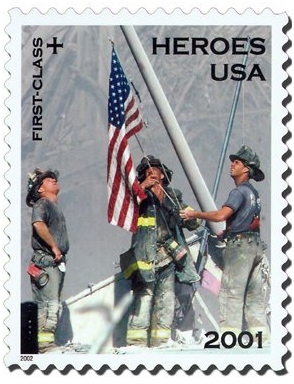
On the eleventh day of September in 2001, we watched television screens in disbelief as two planes crashed into New York’s World Trade Center. We stared in horror at images of the towers collapsing and killing thousands. Trying to make sense of the senseless, we watched while three New York City fire fighters raised the Stars and Stripes over the ruble. That simple act comforted. The flag reminded us that those killed in the attacks had each became a part of America’s history of sacrifice. It reminded us that we all are part of something greater than self. We reached out to one another and found unity in our resolve.
In the days and weeks following the attacks, we found unity and a nation. We remembered the values that unite us as a people.
On the first anniversary of the attacks, the United States flag served again as a focal point to comfort us and remind us. Sandy, Utah became the setting for a new memorial. Paul Swenson envisioned a brilliant display of the Star and Stripes. Not one flag raised over rubble, but a mass of flags flying over a green field, a Healing Field. Over three thousand flags, one flag for each casualty of the terrorist attacks.

Healing Field in Sandy, Utah.
Just as the enormity of the attacks overwhelmed us emotionally, the display of three by five foot U. S. flags mounted on eight foot poles impacts the viewer emotionally.
Over the years, the concept of the Healing Field has spread across the Nation to each state and the District of Columbia.

Each year, a Healing Field in Sandy has honored the sacrifices of the September eleventh attack. This year, the ninth visible expression of the Healing Field will rise in front of Sandy’s City Hall. Volunteers will set up the ordered lines of flags in the early evening of Thursday, September 9th and the flags will fly until Monday, September 13th. A Dedication Ceremony will take place on the anniversary of the attack, September Eleventh at Twelve Noon.
Join us at the 2010 Sandy Healing Field. Share with us this moving experience to bring us together as a Nation and as a people.
August 31, 2010 No Comments
I’ll Call Her Old Glory, Boys, Old Glory
There are several versions of the story. As a rule, it is simply related. William Driver, a ship’s captain, receives the gift of a U.S. flag. He names the flag Old Glory. Today the nickname Old Glory is given to all United States flags. Still, that is only part of the story. While the relic now resides in our Nation’s capital, it is a well traveled flag. Made in Salem, Massachusetts; it has sailed at least twice around the world; it was carried to Tennessee; and, after passing through Utah Territory, Old Glory came to rest in pioneer Nevada. Finally, it remained folded, boxed up, and unseen by the public in for sixty years.

In 1824 William Driver took command of a merchant vessel named the Charles Doggett. Proud of her son’s new assignment, William’s mother and several of her friends made him a beautiful ship’s ensign. The flag originally had twenty-four stars. According to several versions of the story, the flag was folded into a triangle for presentation. A minister consecrated the ensign pointing in turn to the three corners of the triangular package, as he intoned the names of the Christian Trinity. At each reference to Diety, the people answered, “Glory, Glory and Glory.” Captain Driver then hoisted his new ships flag and told his crew, “I’ll call her Old Glory, boys, Old Glory.”
A ships ensign did not survive long in the wind and weather of the high seas. We can simply guess that William Driver only flew the ensign on special occasions. When not flying over his ship, Driver stowed Old Glory in a camphor wood sea chest. The flag accompanied Captain Driver to exotic ports around the world.
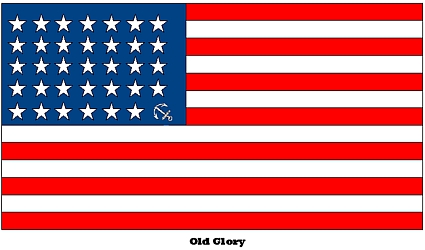
In 1837 Driver quit the sea and moved to Nashville, Tennessee. Still preserving Old Glory in his sea chest, the Captain displayed his ship’s ensign proudly on holidays. His neighbors learned of his fierce patriotism and loyalty to the United States. As the Civil War approached, Captain Driver’s wife and daughters updated Old Glory adding ten new stars and an anchor to the field of blue. The anchor honored the Captain’s years at sea.
Just after Tennessee proclaimed its secession from the Union, William Driver again displayed Old Glory from his Nashville home. Then, fearing rebel soldiers might confiscate his flag, he had it sewn into a quilt cover. Confederates did search his house and property, but never found Old Glory’s hiding place.
In February of 1862, Federal troops entered Nashville. Captain Driver met soldiers from the Ohio 6th Infantry Regiment at the Tennessee Capitol. Driver carried his ship’s flag, Old Glory in his arms. He hoisted the flag over the spire of the Statehouse. The 6th Ohio Regiment adopted “Old Glory” as their motto. Newspapers reported the incident and the nickname of Old Glory spread throughout the Union. So, once only the name William Driver called his ship’s flag, Old Glory became in time the name for all United States flags.
William Driver presented Old Glory to his daughter, Mary Jane Driver Roland. She transported the artifact by train from Nashville, Tennessee to Ogden, Utah Territory. Mary Jane carried the folded flag in her lap during the long trip, fearful it might be lost. From Ogden she traveled by wagon for the remaining three hundred miles to her home in northern Nevada. In 1922, the Smithsonian Institution acquired Old Glory. By this time it was too fragile to unfold. Only black and white photographs existed. For decades textile curators stored the flag unseen by the public. Finally in 1982, the Smithsonian conserved the delicate flag and placed it on display for the first time. Together with the Star Spangled Banner, Old Glory can be seen in the Smithsonian’s National Museum of American History.
August 2, 2010 1 Comment