Category — Flag Facts
Flag Rotation Atop Canada’s National Flagpole

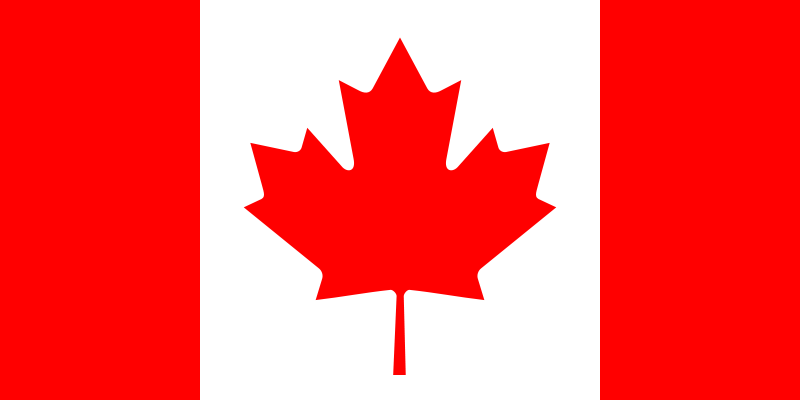
Canada’s beautiful Maple Leaf national flag.
The United States and her neighbor to the north share the longest international border in the world with almost four thousand miles measuring from the Atlantic to the Pacific and an additional fifteen hundred miles of border between Canada and Alaska on the west together totaling a staggering 5,525 miles. In a military sense, this is also the longest undefended border in the world, and the tradition of peace and friendship between the two nations is equally long and impressive.
Canadians have one of the most beautiful and recognizable national flags in the world which consists of a red field with a white square at its center whereupon a single red maple leaf appears. This simple red and white design, using the national colors of Canada, has flown officially since its adoption in 1965.
While many of Canada’s customs are similar to those of the United States, some traditions reflect a distinctly independent heritage, and the differences are interesting. Both nations have representative democracies with a federal government including a legislature made up of two houses. However, the United States is a republic with a congress while Canada is a constitutional monarchy with a parliament. The President is the Head of State in the U.S. while Elizabeth II as Queen of Canada is their Head of State. Each democracy represents its citizens in its own traditional way.

The Peace Tower in Ottawa.
At Canada’s Federal Capital in Ottawa, the main government building is not a domed capitol building, so common in the U.S., but a Parliament Building with a central tower, the Peace Tower, that resembles London’s Elizabeth Tower at the British House of Parliament. The bell known as Big Ben which is housed in this clock tower has become a symbol of government in the United Kingdom.
In Canada, the symbol of government is the Peace Tower. Reaching over three hundred feet in the air, Ottawa’s Peace Tower is topped by a flagpole, recognized as the nation’s flagpole, which flies a Canadian National flag—measuring 7 ½ feet by 15 feet—day and night every day of the year. Weather permitting the flag displayed is changed for a new flag daily. Taking care to insure that the flag never touches the ground or floor, a government worker unfolds and inspects each new flag before refolding and placing it in a bag used to carry the flag to the top of the tower which is the base of the flagpole. The employee can only take an elevator to the observation deck, and then he must climb stairs and ladders for the last one hundred and eight feet to the base of the flagpole. There is a mere four foot square area where the worker can stand as the one day old flag is lowered, folded and placed in the bag before it is replaced with a fresh new one. Given the height, the closeness of space and the ever present wind, the worker wears a safety harness during the daily changing of the flag.
Colonial Flag Company has a flag rotation service to insure customers always have a clean and serviceable flag flying from their flagstaff, and while rotation is made at agreed upon intervals, a daily rotation seems extreme. While daily rotation in Ottawa certainly insures that the flag flying over the Parliament Building is clean and in good repair, a person might wonder what happens to all those flags that are each flown for only one day. They are given free to Canadian residents who make application to receive one. The Canadian government suggests that recipients fly their flags from flagpoles 45 to 50 feet tall which are not supplied. How popular is this Peace Tower flag program? Well, the currently projected wait time to receive a flag flown over the Parliament building is 38 years.
Nevertheless, the government does on occasion present flags in special acknowledgement. When a Canadian Corporal died while serving in Afghanistan, a Member of Parliament from the serviceman’s home town of Halifax in Nova Scotia, presented his father with the flag that had flown on the Peace Tower on the day Corporal Paul Davis died. This was certainly an appropriate and appreciated gesture for the serviceman’s family.
The opportunity to receive a flag flown at the national seat of government is meaningful for Canadians. We can only salute our good neighbor to the north for honoring their national flag. “The Maple Leaf Forever?” Indeed.
March 17, 2013 No Comments
Half Staff Origins
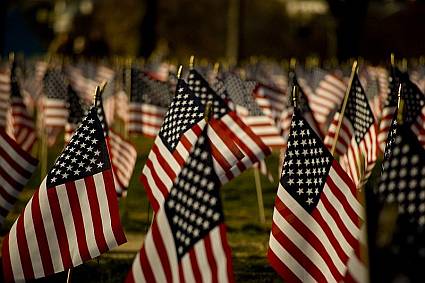
Many of you may have noticed that the flags have been flown at half-staff in the last week or so, first for the tragedy at Sandy Hook Elementary, and most recently in honor of Senator Daniel K. Inouye.
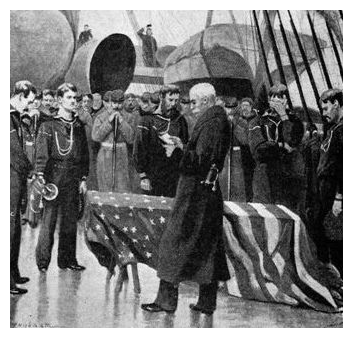
Flying a flag at half-staff means flying the flag below the summit of the flagpole. This is done in many countries as a symbol of respect and mourning or distress. The tradition of flying the flag at half-staff is very old; it is believed to have started in the 17th century. In 1612 the captain of the British ship Heart’s Ease died on a journey to Canada. The sailors lowered the flag to make room for the invisible flag of death. This signified death’s presence, power, and prominence.
You may wonder who can order a flag to be at half-staff. In the United States the President can issue an executive order for the flag to be flown at half-staff upon the death of principal figures of the United States government and others, as a mark of respect to their memory. When the President issues such an order, all government buildings, offices, public schools and military bases are to fly their flags at half-staff. Federal law states that the flags of states and cities, whether residential or commercial, should never be placed above the flag of the United States; thus, all other flags also fly at half-staff when the U.S. flag has been ordered to fly at half-staff.
In the U.S. the flag is to be flown at half-staff in the following situations:
• For thirty days after the death of a current or former president or president-elect
• For ten days after the death of a current vice president, current or retired chief justice, or current speaker of the House of Representatives.
• On the day of death and the following day for a Member of Congress.
• On Memorial Day until noon
• Peace Officers Memorial Day, May 15
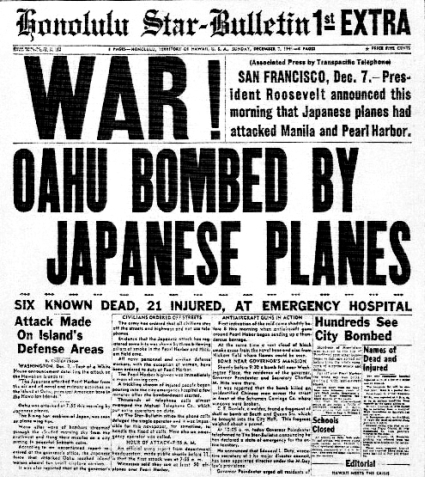
• Pearl Harbor Remembrance Day, December 7
• Patriot Day, September 11
• And also upon presidential proclamation for different tragedies.
You can also participate in displaying the flag at half-staff, demonstrating your honor and respect at your home with a residential flagpole. When lowering a flag to half-staff be sure to first raise the flag to the top of the flagpole and then slowly lower it to half-staff.
December 26, 2012 No Comments
American Flag History
Nothing seems to invoke feelings of freedom and patriotism for American citizens as much as the red white and blue. Seeing an American flag flying proudly on a bright sunny day can lift spirits and make one proud to be called an American. But as patriotic as most Americans may feel when seeing such a sight, many do not know the history of that important symbol.
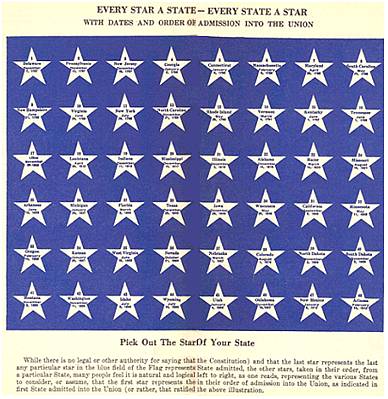
It is common knowledge that the 50 bright white stars represent each state of the Union, and some know that the thirteen red and white lines mark the inception of our countries first original colonies. Seeing the flag flying halfway or “half-staff” is generally known that an important American has passed. But who was the creator, when was it created and what was the inspiration for our flag?
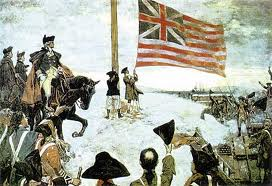
Betsy Ross was the woman who sewed the first flag. The year was 1776 and the United States was fighting for its freedom from the British. However there has been some debate over whom the creator of the Stars and Stripes was, it is likely Francis Hopkinson was the designer. No country is complete without a standard to symbolize who they represent. This was an important step for this young country in declaring independence and becoming a sovereign nation.
America’s first flag consisted of the red and white stripes, but leaned more towards that of its ruling oppressors, with the British symbol where the blue background and stars now reside. 1777 was the first year that the stars, representing states, was introduced. As the country grew and gained more states the number of stars went up until the 50 that is currently flying on today’s flag.
The colors of the flag were no mere accident either. Each color is representative of what America stands for. Red is representative of hardiness and valor, traits which the country has been known for, both in wartime and helping other countries in need. White is a symbol for purity and innocence, traits that are representative of the citizens of the United States. And finally the blue field, portraying vigilance and justice characteristics that America has been known for, treating all men equal and providing safety through a fair justice system.
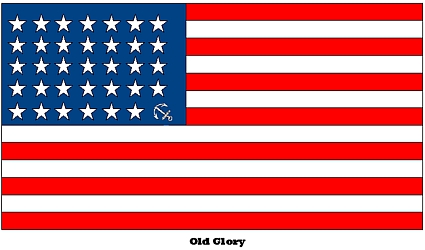
America’s flag has many customs and traditions surrounding it which adds to the pride in its illustrious history. It has gained the nicknames of Star Spangled Banner, Stars and Stripes and of course the famous Old Glory. A flag was bestowed upon a young whaling vessel Captain, whom proudly referred to it as “Old Glory” as it flew on his vessels mast.
The United States flag, with all of its symbolism and history is now seen across the world. It flies above Americas Embassies and war zones around the world representing an idea and hope of freedom for many of the worlds oppressed people. It was a symbol to the British that freedom could be obtained, that justice would prevail and continues to maintain its highly regarded status to this day.
December 3, 2012 No Comments