MANY VOICES, ONE FLAG

Category — Flag Facts

This Monday is Presidents Day

Since April 30, 1789, this country has had a President. Washington to Obama makes 44 individuals. And then there was Grover Cleveland our 22nd & 24th President. At the end of Cleveland’s first term in 1889, Mrs. Cleveland turned to the servants at the White House, as she was leaving and said “we will be back,” she was right.

Grover Cleveland, 22nd and 24th President of the United States.

Their lives were hard in the early years of the Presidency as the seat of Government was moved from New York to Philadelphia to something that was to be called the District of Columbia. A piece of ground between Virginia and Maryland, we now call Washington, D.C., the District or many other things when we get angry. The District was named to honor Columbus, but re-named Washington City for George Washington after his death.

President’s for the first 150 years were plagued by office seekers and members of Congress seeking some favor for an individual or their states. Not much has changed but access to get to the President has become nearly impossible. People in the 19th Century could walk right into the White House (The Executive Mansion as it was known before 1901) and ask to meet with the President. Limits on their powers and flexibility on what they can do has also been limited by Congress in an effort to place some checks and balances in our system of government.

We use to honor President’s such as Washington and Lincoln on their birthday’s February 12th & 22nd but Congress felt we should honor all former President’s with one day in February.

George Washington, 1st President of the United States.

Abraham Lincoln, 16th President of the United States.

Four President’s have surrender their lives in performing their duties, all died by assassin’s bullets. Lincoln, Garfield, McKinley and Kennedy. Others have die in office like William H. Harrison who only served 31 days to Franklin D. Roosevelt who served longer than any other man.

Presidents have the burden of organizing a government after they are elected. The former President takes all their papers and files with them, the new President come to an empty desk and always a large list of problems. He only has ideas that he wishes to develop into policy and supporters who will help him achieve his goals.

Presidents George H. W. Bush, Obama, George W. Bush, Clinton, and Carter in Oval Office.

It has been an honor to have worked for 5 President’s; I have enjoyed it, but still don’t understand why an individual would want such a job with the problems and dangers that the job comes with.

Once a year we honor these men, showing them the respect they deserve, honor them, fly the Flag!

February 20, 2011   No Comments

The History of the Flag of Utah

(Prepared by Ronald L. Fox, John Hartvigsen, David Rindlisbach, Bill Wing and Paul Swenson, with assistance of the Utah State Division of History and the Utah State Archives)

Utah’s first flag was made in March of 1903 by ZCMI seamstress, Agnes Tuedt Frenelius at the direction of the Utah State Society of the Daughters of the Revolution.  The organization received a request from Governor Heber M. Wells, for a flag to be display at the St. Louis World’s Fair.

The word “Utah” was added to the bottom of the flag sometime after 1905.

The flag above was adopted by Legislature as the state flag through SJR 17 by Senate President Henry Gardner on March 9, 1911.

Utah’s flag celebrates its centennial anniversary this year from when the flag was originally adopted in 1911. HCR 2 (Rep. Julie Fisher) reaffirms the statute of 1913 (the last code to describe Utah’s flag) and encourages flag manufacturers to follow current Utah code.  The resolution provides an opportunity for Utah’s school children to learn about the political process while learning about the flag’s history and encourages future generations to honor the flag and those who came before us.  Flags currently in use may continue to be used until no longer in good repair.

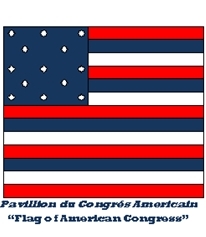
The picture above is a copy of the only known photo of the 1913 flag (minimal quality from an old newspaper).  The description and colors were taken from language found in the Senate Journal and the original resolution found in the State Archives.

Below is the current Utah flag. In 1922, the “1847” was mistakenly put just above the “1896” and not on the shield, which does not follow the statute and has been perpetuated to this day.

Utah’s flag celebrates its centennial anniversary this year from when the flag was originally adopted in 1911.  HCR 2 (Rep. Julie Fisher) reaffirms the statute of 1913 (the last code to describe Utah’s flag) and encourages flag manufacturers to follow current Utah code.

The resolution provides an opportunity for Utah’s school children to learn about the political process while learning about the flag’s history and encourages future generations to honor the flag and those who came before us.

Flags currently in use may continue to be used until no longer in good repair.


The graphic above is a representation of the flag based on the 1913 resolution, and the surviving photograph. The description and colors were taken from language found in the Senate Journal and the original resolution found in the State Archives.

The flag is based on the Utah seal approved on April 3, 1896 through H. B. 164 by Rep. Edward Critchlow, as required by the Utah Constitution.  It was based on a design submission by Harry Edwards and Charles M. Jackson.  The flag displays an American bald eagle, a shield and six arrows which represent the six Indian tribes found in the territory at statehood.  Also displayed are the state motto, “INDUSTRY”, the beehive, the state flower the sego lily, (also adopted in 1911), the name “UTAH” and the year the pioneers enter the valley 1847.  The shield is surrounded by two partially shown period US flags on staffs with the date of statehood, 1896 below.  A thin gold ring surrounding the crest and gold fringe on its border finishes the flag.

January 31, 2011   1 Comment

Flag Facts: Celebrate Flags Throughout the Year!

The United States and other nations have official calendars listing Flag Days on which it is appropriate to fly their flags.

In 2011 Colonial Flag will highlight selected Flag Days celebrated in the United States and around the world.  These flag days are Flag Facts and in order to highlight these we have compiled a list of Flag Days celebrated in America as well as important Flag Days in other nations.  To spotlight these special days each month we will announce on our Web site and post articles to our blog (flag-post.com).  Additionally, we will make postings to our Facebook page, and the Colonial Flag Showroom will host special events to lead the celebrations.

Click here to see the compiled list of Flag Days.  While it would be impossible to include all Flag Days, we want to do our best to remember the days that are important to our community!

Contact us if you have you a Flag Day to suggest that we may have missed.  Share with us any observance your group may be planning which includes the display of flags.

Flags add color and excitement to any scene, but additionally they have meaning to those who display them.  They remind us of history and inspire us to action.  Join us at Colonial Flag in the celebration of flags throughout the year!

January 2, 2011   No Comments