Category — Flag News
Healing Field: Honoring Sacrifices
What does a flag mean? Why is it important? The questions are simple, the answers are not. As with many simple questions, these answers are not easy to express. The United States flag is, by its very nature, an emblem infused with feeling. Old Glory reflects the most momentous events of our national history. Yet the flag can also be very personal. Sometimes in our national experience the momentous and the personal collide.

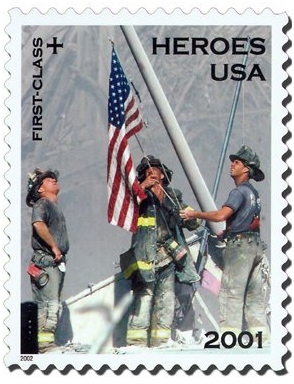
On the eleventh day of September in 2001, we watched television screens in disbelief as two planes crashed into New York’s World Trade Center. We stared in horror at images of the towers collapsing and killing thousands. Trying to make sense of the senseless, we watched while three New York City fire fighters raised the Stars and Stripes over the ruble. That simple act comforted. The flag reminded us that those killed in the attacks had each became a part of America’s history of sacrifice. It reminded us that we all are part of something greater than self. We reached out to one another and found unity in our resolve.
In the days and weeks following the attacks, we found unity and a nation. We remembered the values that unite us as a people.
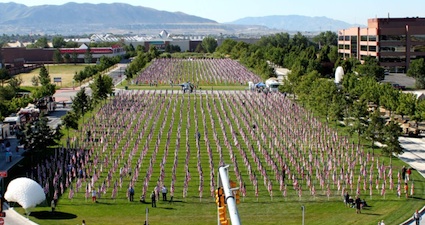
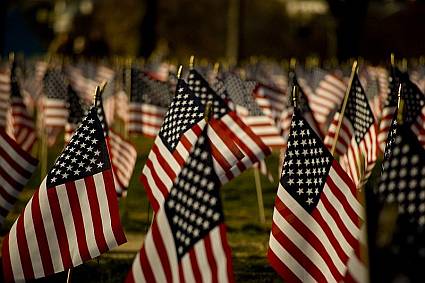
On the first anniversary of the attacks, the United States flag served again as a focal point to comfort us and remind us. Sandy, Utah became the setting for a new memorial. Paul Swenson envisioned a brilliant display of the Star and Stripes. Not one flag raised over rubble, but a mass of flags flying over a green field, a Healing Field. Over three thousand flags, one flag for each casualty of the terrorist attacks.

Healing Field in Sandy, Utah.
Just as the enormity of the attacks overwhelmed us emotionally, the display of three by five foot U. S. flags mounted on eight foot poles impacts the viewer emotionally.
Over the years, the concept of the Healing Field has spread across the Nation to each state and the District of Columbia.

Each year, a Healing Field in Sandy has honored the sacrifices of the September eleventh attack. This year, the ninth visible expression of the Healing Field will rise in front of Sandy’s City Hall. Volunteers will set up the ordered lines of flags in the early evening of Thursday, September 9th and the flags will fly until Monday, September 13th. A Dedication Ceremony will take place on the anniversary of the attack, September Eleventh at Twelve Noon.
Join us at the 2010 Sandy Healing Field. Share with us this moving experience to bring us together as a Nation and as a people.
August 31, 2010 No Comments
Celebrating 50 Years – 50 Stars on 7/4/2010
On July 4th 2010, the 50 Star United States flag officially celebrates its 50th year of flying proudly over the United States of America.
As you know, the State of Hawaii became the 50th state on August 21st, 1959 and following the United States Code Title 4, Chapter 1 pertaining to the flag, a fiftieth star was added on July 4th, 1960.
Back in 2007 the 50 star U.S. flag became the longest continually used official version of the U.S. flag and as of July 4th, 2010, celebrates its 50th year!
When Alaska and Hawaii were being considered for statehood back in the 1950s, more than 1,500 flag designs were “spontaneously” sent to President Eisenhower. A few of these designs had 49 stars, however, the majority were 50-star proposals. Interestingly, at least 3 designs, and some claim more, were identical to the current design of our U.S. Flag.
Of all of these proposals, a flag design created by the (at the time) 17-year old Robert G. Heft in 1958 received the most publicity. Mr. Heft turned a history class project into a history making event, when he designed America’s newest national flag which began official usage on July 4th, 1960.

Bob Heft holds his original 50-star flag.
Mr. Heft’s mother worked as a seamstress, but refused to do any of the work for him. Mr. Heft ended up only receiving a B- grade for this history class project. After discussing the grade with his teacher, it was somewhat jokingly agreed that if the flag were to be accepted by Congress, the grade would be reassessed.
Mr. Heft’s flag design was eventually chosen and adopted by presidential proclamation after Alaska and before Hawaii were admitted into the union
Following his 50-star banner design, Mr. Heft became concerned that a fifty-first star might be required, so he also made a 51 star flag having alternating rows of nine and eight stars, 9-8-9-8-9-8 equaling 51 bright and shining stars.
The original flag that made Heft famous 5 decades ago is faded now after having traveled to many, many places, a good 2.5 million miles, flying over all 50 states, 131 American embassies and hundreds of historical locations around the world.
This historic 50 Years – 50 Stars, collectors edition commemorative flag set has been made available for a limited time by Colonial Flag – America’s Flag Store. Online as well as our Showroom!
This exclusive set includes the highest quality, beautifully sewn U.S. flag currently made in the U.S.A as well as a commemorative stamp on the flag header, an official certificate with the history of the flag and little known facts regarding the 50 Star U.S. flag.
June 7, 2010 No Comments
Three Cheers for the Red, White & Blue!
On June 14th in 1777 the Second Continental Congress passed a resolution proposed by the Marine Committee: “Resolved: that the flag of the United States be made of thirteen stripes, alternate red and white; that the union be thirteen stars, white on a blue field, representing a new constellation.”
On first glance, the description seems sufficient. Knowing, as we do, what the first U.S. flag looked like, we mentally check off the items: thirteen red and white stripes, check; a union, check; thirteen white stars on blue, check. Yes, everything is there. On the other hand, there are many details not clearly defined in that resolution. Is it seven red stripes or only six? How big is the union? How many points does each star have? What is the pattern for the stars? A circle of thirteen? Twelve stars in a circle surrounding a central star? Or are the stars displayed in rows? How many rows? Is the flag square or rectangular? If we had never seen an American flag, we would have a lot of questions that the Flag Resolution did not answer. Many variants are possible all following the description in the flag resolution.
Strangely, the flags actually used during the American Revolution were even more diverse than that. It was not uncommon for early U.S. flags to boast red, white and . . . blue stripes. As a matter of fact, Benjamin Franklin and John Adams, our commissioners to France, described the flag in 1778 as follows: “It is with pleasure that we acquaint your Excellency that the flag of the United States of America consists of 13 stripes, alternately red, white and blue; a small square in the upper angle, next to the flag staff, is a blue field, with 13 white stars, denoting a new Constellation.”
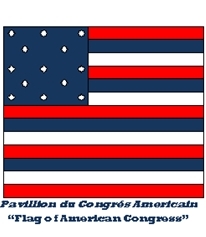
Some illustrations of the period show U.S. flags with red white and blue stripes. John Paul Jones sailed into the Dutch harbor at Texel in 1779 with two ships. One was an American vessel, the Alliance. The second was a British ship that Jones had captured. The British protested to Dutch authorities that the ships did not fly recognized national ensigns; therefore, Jones and his crews were pirates. Quietly, the Dutch sent an artist down to the wharf with instructions to paint illustrations of the flags flying from the two American ships. They then placed the pictures in their files. When the British complained again, the Dutch pulled out the paintings of the two flags. The Dutch did recognize the flags as genuine national flags. A few years later, in 1793, a sheet of national flags was published in Augsberg, Germany. It showed the U.S. flag labeled in French “Pavillion du Congrés Americain,” which translates “Flag of American Congress.” It also shows red, white and blue stripes.

This points out that there were actually many variations of the Stars and Stripes in the early years of the republic. Details were pretty much left up to the flag maker. If it had stars, stripes and was red white and blue, that was close enough. Today, all of these questions have been answered. The description for the United States flag is extremely specific in every detail. Even the ratios of each dimension are spelled out. If the hoist (width) is given the ratio value of 1.0, then the fly (length) is 1.9. Even the ratio of the stars has been computed. Each of the fifty stars is officially designated as being a ratio of 0.0616 of the hoist. Click for the chart here.
Also, learn more here…
If you want to make a flag, better get out your scientific calculator. Better yet, buy a ready made flag. Colonial Flag will make sure you get a flag that is correct. Three cheers for the red white and blue!
June 3, 2010 No Comments