MANY VOICES, ONE FLAG

Category — Flags

New Glory for an Old Flag: Utah State Flag Day is Official

Colonial Flag Company is celebrating  the Utah State Flag’s birthday in a big way.  Company seamstresses have produced a gigantic Utah State Flag which was raised today, the 9th of March, on the 80 foot flagpole in front of the Utah State Capitol by Lieutenant Governor Greg Bell.  The 20 by 30 foot flag, which weighs over 22 pounds folded, will fly all day in honor of the one hundredth anniversary of the adoption of the Utah State Flag.

The huge flag has had a big impact.  The Utah State Senate has been considering House Bill 490 to officially designate March 9th as Utah State Flag Day.  However, with the State Senate overburdened by critical legislation, it seemed likely that the session would end without the Senate taking action on H.B. 490.  Seeing Colonial’s huge flag flying on the centennial anniversary day of the Utah State Flag inspired the senators to suspend the rules and pass House Bill 490.  Consequently from this year forward, March 9th is officially recognized as Utah State Flag Day.

On Thursday, March 10th the huge flag will be raised in front of Colonial Flag Company Headquarters and Showroom located at 9390 South 300 West in Sandy, Utah.

The flag, sewn entirely on site in Sandy, is a beautiful example of the flag-making art.  It is double appliquéd so that the image is perfect on both sides.  The pattern, produced by Colonial Flag’s graphic artist, David Rindlisbach, honors the first color version of the Utah State Flag adopted in 1913.

Although the story of the Utah State Flag stretches back to 1903, its official history began on March 9th in 1911 when the design of the first flag became law.  While the first design was a white emblem embroidered on a blue field, the current color version was adopted in 1913.  An error made in the design of a Utah State Flag produced in 1922 has been repeated by flag-makers until this year.  Less than a month ago the Utah Legislature passed House Concurrent Resolution 2 to correct that error.  However, the Resolution allows existing flags to be used until they need to be replaced.

Consequently, at this first celebration of Utah State Flag Day, the gigantic Utah flag is one of only a relatively small number of correct Utah State Flags in existence.  The others are part of Colonial Flag Company’s initial order of the correct pattern, and are available for sale at Colonial Flag Company’s Showroom located at 9390 South 300 West in Sandy.

Because of Colonial Flag Company’s efforts there were correct flags on display to celebrate the Centennial of the Utah State Flag, the first Utah State Flag Day.  We are proud to be a part of honoring the Utah State Flag on its centennial.

March 9, 2011   No Comments

The History of the Flag of Utah

(Prepared by Ronald L. Fox, John Hartvigsen, David Rindlisbach, Bill Wing and Paul Swenson, with assistance of the Utah State Division of History and the Utah State Archives)

Utah’s first flag was made in March of 1903 by ZCMI seamstress, Agnes Tuedt Frenelius at the direction of the Utah State Society of the Daughters of the Revolution.  The organization received a request from Governor Heber M. Wells, for a flag to be display at the St. Louis World’s Fair.

The word “Utah” was added to the bottom of the flag sometime after 1905.

The flag above was adopted by Legislature as the state flag through SJR 17 by Senate President Henry Gardner on March 9, 1911.

Utah’s flag celebrates its centennial anniversary this year from when the flag was originally adopted in 1911. HCR 2 (Rep. Julie Fisher) reaffirms the statute of 1913 (the last code to describe Utah’s flag) and encourages flag manufacturers to follow current Utah code.  The resolution provides an opportunity for Utah’s school children to learn about the political process while learning about the flag’s history and encourages future generations to honor the flag and those who came before us.  Flags currently in use may continue to be used until no longer in good repair.

The picture above is a copy of the only known photo of the 1913 flag (minimal quality from an old newspaper).  The description and colors were taken from language found in the Senate Journal and the original resolution found in the State Archives.

Below is the current Utah flag. In 1922, the “1847” was mistakenly put just above the “1896” and not on the shield, which does not follow the statute and has been perpetuated to this day.

Utah’s flag celebrates its centennial anniversary this year from when the flag was originally adopted in 1911.  HCR 2 (Rep. Julie Fisher) reaffirms the statute of 1913 (the last code to describe Utah’s flag) and encourages flag manufacturers to follow current Utah code.

The resolution provides an opportunity for Utah’s school children to learn about the political process while learning about the flag’s history and encourages future generations to honor the flag and those who came before us.

Flags currently in use may continue to be used until no longer in good repair.


The graphic above is a representation of the flag based on the 1913 resolution, and the surviving photograph. The description and colors were taken from language found in the Senate Journal and the original resolution found in the State Archives.

The flag is based on the Utah seal approved on April 3, 1896 through H. B. 164 by Rep. Edward Critchlow, as required by the Utah Constitution.  It was based on a design submission by Harry Edwards and Charles M. Jackson.  The flag displays an American bald eagle, a shield and six arrows which represent the six Indian tribes found in the territory at statehood.  Also displayed are the state motto, “INDUSTRY”, the beehive, the state flower the sego lily, (also adopted in 1911), the name “UTAH” and the year the pioneers enter the valley 1847.  The shield is surrounded by two partially shown period US flags on staffs with the date of statehood, 1896 below.  A thin gold ring surrounding the crest and gold fringe on its border finishes the flag.

January 31, 2011   1 Comment

The U. S. President’s Flag and Seal

When the President of the United States appears on camera, we normally see a representation of the Presidential seal attached to his podium and the Presidential flag displayed at his side. Today, these symbols of Presidential power and authority share the same design.

Although there have been several Presidential seals and even more Presidential flags, their various designs have basically run parallel throughout our nation’s history.

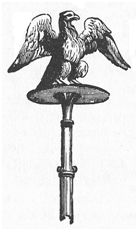
Consider the Presidential seal seen above. Not a plaque made to be displayed on a platform, this engraved seal die was cut to make wax impressions that were applied to documents and letters, as true seals. Made perhaps as early as 1845 during the administration of James K. Polk, the seal found use during the presidencies of Polk, Fillmore, Pierce, Buchanan and Lincoln. Lincoln replaced it in late 1864 with a seal showing thirty-six stars, the full complement of stars to represent all states: North and South. The “old seal” as it was later called disappeared until located and recognized by a Utah researcher, Ronald Fox. The seal’s design is strikingly similar to the design of a Presidential flag illustrated in a little book entitled Maritime Flags of All Nations published in London in 1848. The design and the eagle’s wings are extended to fill the flag’s rectangular space and a red scroll with the motto E. Pluribus Unum was added; nevertheless, the parallels between seal and flag are obvious.

For both emblems, the American eagle holds the olive branch of peace in the right talon and the arrows of war in its left claw. This clearly symbolizes the U.S. Presidents authority as Commander-in-chief. A civilian head of the armed forces charged to maintain peace with military might when required.

January 20, 2011   No Comments