Category — Historic Documents
The History of the Flag of Utah
(Prepared by Ronald L. Fox, John Hartvigsen, David Rindlisbach, Bill Wing and Paul Swenson, with assistance of the Utah State Division of History and the Utah State Archives)
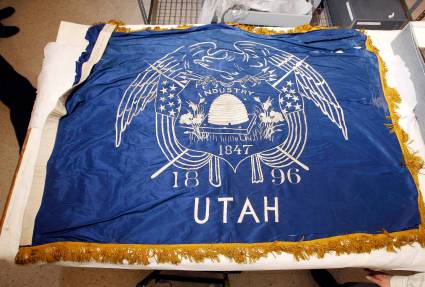
Utah’s first flag was made in March of 1903 by ZCMI seamstress, Agnes Tuedt Frenelius at the direction of the Utah State Society of the Daughters of the Revolution. The organization received a request from Governor Heber M. Wells, for a flag to be display at the St. Louis World’s Fair.

The word “Utah” was added to the bottom of the flag sometime after 1905.
The flag above was adopted by Legislature as the state flag through SJR 17 by Senate President Henry Gardner on March 9, 1911.
Utah’s flag celebrates its centennial anniversary this year from when the flag was originally adopted in 1911. HCR 2 (Rep. Julie Fisher) reaffirms the statute of 1913 (the last code to describe Utah’s flag) and encourages flag manufacturers to follow current Utah code. The resolution provides an opportunity for Utah’s school children to learn about the political process while learning about the flag’s history and encourages future generations to honor the flag and those who came before us. Flags currently in use may continue to be used until no longer in good repair.

The picture above is a copy of the only known photo of the 1913 flag (minimal quality from an old newspaper). The description and colors were taken from language found in the Senate Journal and the original resolution found in the State Archives.
Below is the current Utah flag. In 1922, the “1847” was mistakenly put just above the “1896” and not on the shield, which does not follow the statute and has been perpetuated to this day.

Utah’s flag celebrates its centennial anniversary this year from when the flag was originally adopted in 1911. HCR 2 (Rep. Julie Fisher) reaffirms the statute of 1913 (the last code to describe Utah’s flag) and encourages flag manufacturers to follow current Utah code.
The resolution provides an opportunity for Utah’s school children to learn about the political process while learning about the flag’s history and encourages future generations to honor the flag and those who came before us.
Flags currently in use may continue to be used until no longer in good repair.

The graphic above is a representation of the flag based on the 1913 resolution, and the surviving photograph. The description and colors were taken from language found in the Senate Journal and the original resolution found in the State Archives.
The flag is based on the Utah seal approved on April 3, 1896 through H. B. 164 by Rep. Edward Critchlow, as required by the Utah Constitution. It was based on a design submission by Harry Edwards and Charles M. Jackson. The flag displays an American bald eagle, a shield and six arrows which represent the six Indian tribes found in the territory at statehood. Also displayed are the state motto, “INDUSTRY”, the beehive, the state flower the sego lily, (also adopted in 1911), the name “UTAH” and the year the pioneers enter the valley 1847. The shield is surrounded by two partially shown period US flags on staffs with the date of statehood, 1896 below. A thin gold ring surrounding the crest and gold fringe on its border finishes the flag.
January 31, 2011 1 Comment
Bill of Rights – Celebrating its 218th Birthday

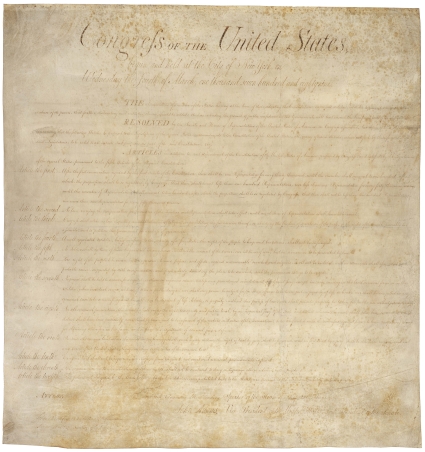
One of America’s Charters, the “Bill of Rights,” celebrated its 218th birthday on Tuesday, December 15, 2009. With Virginia’s affirmative vote on December 15, 1791, they became the last state to ratify the first 10 amendments to our new Constitution. They are simply referred to as the Bill of Rights, but they are anything but simple.
The rights and principals adopted that day where some of the most important gifts granted to us by our fellow citizens. They were a revolutionary statement of protection offered to the common man and extension of England’s Magna Carta.
One sheet of parchment declared to the world that our citizens had the rights of freedom of Religion, and of Speech and Press; we could assemble freely and petition government for grievances.
Furthermore, it preserved our rights to bear arms, that our homes could not be taken over by the military, it protected us from improper search or seizures without a valid warrant.
It continued by addressing that certain crimes had to be put by a Grand Jury, and that an individual could not be tried for the same offense twice, nor be a witness against himself.
It clearly stated we could not be deprived of life, liberty or property, without due process or property taken by government without giving just compensation. Speedy trails, impartial juries, being tried in the area of which you are accused, and that you may face your accusers were guaranteed. The use of common law, trail by jury, and that bail will be available and fines will not be excessively imposed nor will cruel or unusual punishment be inflected.
Finally, that the powers of the Federal government are limited and that all other powers lie with the States and to the People themselves.

First Congress listens to Madison present Bill of Rights.

James Madison, "Father of the Constitution," first author of the Bill of Rights.
We all need to read, understand, and celebrate these important doctrines. We learn them in school, but many do not remember them long after, and they are often taken for granted. Have you seen Jay Leno’s segment called Jay-walking, it is embarrassing.
Many of our forefathers died protecting these rights and you do not have to look to far in your own neighborhoods today to see someone who has served in our military, our legislatures or local governments, our first responders and our courts of law. These are the people on the front line of democracy.
During the last World War one of America’s great painters Norman Rockwell brought to life four master works known as the “four freedoms.” These paintings echoed some of the key principals forged in the Bill of Rights.

"Four Freedoms" series painted by Norman Rockwell in 1943.
Take time and read this very short document that is so important to all of us, as citizens of this great land.
Show your spirit and belief in America, fly the Flag!
December 14, 2009 No Comments