Category — State Flags
The History of the Flag of Utah
(Prepared by Ronald L. Fox, John Hartvigsen, David Rindlisbach, Bill Wing and Paul Swenson, with assistance of the Utah State Division of History and the Utah State Archives)
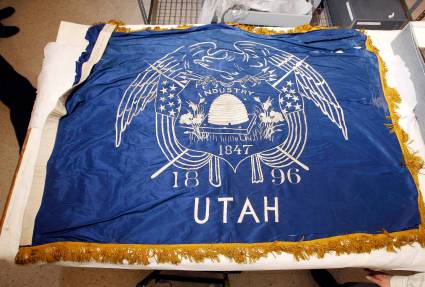
Utah’s first flag was made in March of 1903 by ZCMI seamstress, Agnes Tuedt Frenelius at the direction of the Utah State Society of the Daughters of the Revolution. The organization received a request from Governor Heber M. Wells, for a flag to be display at the St. Louis World’s Fair.

The word “Utah” was added to the bottom of the flag sometime after 1905.
The flag above was adopted by Legislature as the state flag through SJR 17 by Senate President Henry Gardner on March 9, 1911.
Utah’s flag celebrates its centennial anniversary this year from when the flag was originally adopted in 1911. HCR 2 (Rep. Julie Fisher) reaffirms the statute of 1913 (the last code to describe Utah’s flag) and encourages flag manufacturers to follow current Utah code. The resolution provides an opportunity for Utah’s school children to learn about the political process while learning about the flag’s history and encourages future generations to honor the flag and those who came before us. Flags currently in use may continue to be used until no longer in good repair.

The picture above is a copy of the only known photo of the 1913 flag (minimal quality from an old newspaper). The description and colors were taken from language found in the Senate Journal and the original resolution found in the State Archives.
Below is the current Utah flag. In 1922, the “1847” was mistakenly put just above the “1896” and not on the shield, which does not follow the statute and has been perpetuated to this day.

Utah’s flag celebrates its centennial anniversary this year from when the flag was originally adopted in 1911. HCR 2 (Rep. Julie Fisher) reaffirms the statute of 1913 (the last code to describe Utah’s flag) and encourages flag manufacturers to follow current Utah code.
The resolution provides an opportunity for Utah’s school children to learn about the political process while learning about the flag’s history and encourages future generations to honor the flag and those who came before us.
Flags currently in use may continue to be used until no longer in good repair.

The graphic above is a representation of the flag based on the 1913 resolution, and the surviving photograph. The description and colors were taken from language found in the Senate Journal and the original resolution found in the State Archives.
The flag is based on the Utah seal approved on April 3, 1896 through H. B. 164 by Rep. Edward Critchlow, as required by the Utah Constitution. It was based on a design submission by Harry Edwards and Charles M. Jackson. The flag displays an American bald eagle, a shield and six arrows which represent the six Indian tribes found in the territory at statehood. Also displayed are the state motto, “INDUSTRY”, the beehive, the state flower the sego lily, (also adopted in 1911), the name “UTAH” and the year the pioneers enter the valley 1847. The shield is surrounded by two partially shown period US flags on staffs with the date of statehood, 1896 below. A thin gold ring surrounding the crest and gold fringe on its border finishes the flag.
January 31, 2011 1 Comment
The Alaska State Flag
I received numerous “astronomy lessons” from my dad when I was a younger boy. One of the first things he taught me, that I can recall, was about one particular star, called the “North Star” (also known as the “Pole Star”).
The North Star is a very prominent star that is approximately aligned with the Earth’s axis or rotation. It is a star whose apparent position is close to one of the “celestial poles,” and which lies directly overhead when viewed from the Earth’s North Pole.

The North Star (Polaris) as seen by the Hubble Space Telescope.
Interestingly, while other stars’ apparent positions in the sky change throughout the night, the North Star’s apparent position remains essentially fixed.
Now, the Alaska State Flag consists of eight gold stars, including the (bigger) North Star. The other 7 stars form the “Big Dipper.”
The Alaska State Flag was designed back in 1927, 80+ years ago, by Benny Benson, a 13-year old boy, native of Alaska, for a competition to create a flag for the then “Alaska Territory.” Till that time, Alaskans flew the U.S. flag since the territory was purchased from Russia in 1867.
There were over 700 submissions! To celebrate Benson’s achievement, he was awarded $1,000 and was given an engraved watch. He explained that for the design of the flag, he had looked to the sky for the symbols he included on his flag. Included with his submission was the following description:
“The blue field is for the Alaska sky and the “forget-me-not,” an Alaskan flower. The North Star is for the future state of Alaska, the most northerly in the union. The Dipper is for the Great Bear – symbolizing strength.“
The Big Dipper symbolizes a bear, an animal indigenous to the State of Alaska. As shown on the Alaska State Flag, the stars can be used as a guide to locate the North Star and determine true north, which, interestingly, varies considerably from a compass bearing in Alaska…
March 12, 2010 No Comments
Utah’s First Flag Finally Found
More than one century ago, in 1903, Utah had a problem. Following the invitation by the St. Louis World Fair to participate in a parade of states, and with only a few months before the start of the parade, the State of Utah was unprepared, it had no state flag!
However, on May 1, 1903, in St. Louis, the delegation from the Union’s youngest state marched proudly with their new flag in the parade of states. A photograph was taken of the delegation standing around the flag.
More than 100 years later, in 2008, Ronald Fox, also contributor to flag-post.com, found the photograph of the flag.
As some of you know, Ron is a “history buff” and an indefatigable artifact hunter. Like a pit bull, he latched onto the idea of finding the flag…
March 10, 2010 No Comments