MANY VOICES, ONE FLAG

Category — World Flags

I’ll Call Her Old Glory, Boys, Old Glory

There are several versions of the story.  As a rule, it is simply related.  William Driver, a ship’s captain, receives the gift of a U.S. flag.  He names the flag Old Glory.  Today the nickname Old Glory is given to all United States flags.  Still, that is only part of the story.  While the relic now resides in our Nation’s capital, it is a well traveled flag.   Made in Salem, Massachusetts;  it has sailed at least twice around the world; it was carried to Tennessee; and, after passing through Utah Territory, Old Glory  came to rest in pioneer Nevada.  Finally, it remained folded, boxed up, and unseen by the public in for sixty years.

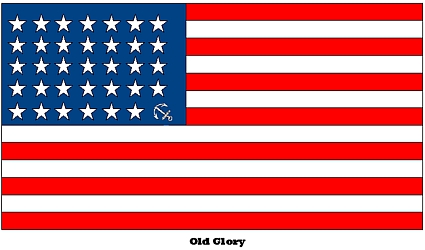
Old Glory

In 1824 William Driver took command of a merchant vessel named the Charles Doggett.  Proud of her son’s new assignment, William’s mother and several of her friends made him a beautiful ship’s ensign.  The flag originally had twenty-four stars.  According to several versions of the story, the flag was folded into a triangle for presentation.  A minister consecrated the ensign pointing in turn to the three corners of the triangular package, as he intoned the names of the Christian Trinity.  At each reference to Diety, the people answered, “Glory, Glory and Glory.”  Captain Driver then hoisted his new ships flag and told his crew, “I’ll call her Old Glory, boys, Old Glory.”

A ships ensign did not survive long in the wind and weather of the high seas.  We can simply guess that William Driver only flew the ensign on special occasions.  When not flying over his ship, Driver stowed Old Glory in a camphor wood sea chest.  The flag accompanied Captain Driver to exotic ports around the world.

In 1837 Driver quit the sea and moved to Nashville, Tennessee.  Still preserving Old Glory in his sea chest, the Captain displayed his ship’s ensign proudly on holidays.  His neighbors learned of his fierce patriotism and loyalty to the United States.  As the Civil War approached, Captain Driver’s wife and daughters updated Old Glory adding ten new stars and an anchor to the field of blue.  The anchor honored the Captain’s years at sea.

Just after Tennessee proclaimed its secession from the Union, William Driver again displayed Old Glory from his Nashville home.  Then, fearing rebel soldiers might confiscate his flag, he had it sewn into a quilt cover.  Confederates did search his house and property, but never found Old Glory’s hiding place.

In February of 1862, Federal troops entered Nashville.  Captain Driver met soldiers from the Ohio 6th Infantry Regiment at the Tennessee Capitol.  Driver carried his ship’s flag, Old Glory in his arms.  He hoisted the flag over the spire of the Statehouse.  The 6th Ohio Regiment adopted “Old Glory” as their motto.  Newspapers reported the incident and the nickname of Old Glory spread throughout the Union.  So, once only the name William Driver called his ship’s flag, Old Glory became in time the name for all United States flags.

William Driver presented Old Glory to his daughter, Mary Jane Driver Roland.  She transported the artifact by train from Nashville, Tennessee to Ogden, Utah Territory.  Mary Jane carried the folded flag in her lap during the long trip, fearful it might be lost.   From Ogden she traveled by wagon for the remaining three hundred miles to her home in northern Nevada.  In 1922, the Smithsonian Institution acquired Old Glory.  By this time it was too fragile to unfold.  Only black and white photographs existed.  For decades textile curators stored the flag unseen by the public.  Finally in 1982, the Smithsonian conserved the delicate flag and placed it on display for the first time.  Together with the Star Spangled Banner, Old Glory can be seen in the Smithsonian’s National Museum of American History.

August 2, 2010   No Comments

Syttende Mai

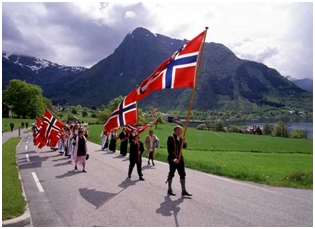
The Norwegian flag plays a central role on the celebration of Norway’s great national holiday.  Sometimes called the “Constitution Day” or the “National Day,” it is most often simply called “syttende mai,” Norwegian for May Seventeenth.

Syttende Mai

It celebrates the day in 1814 when Norway adopted its Constitution and declared its independence.   Sadly, the Norwegians were forced into an unwanted union with Sweden.  A symbol of the union appeared on their flag.  The Union device was an awkward design that combined the Swedish and Norwegian flags.  The Norwegians disliked the union emblem and said it looked like a bowl of herring salad.  They longed for the return of their “clean flag” with the union symbol removed.  They longed for their independence.  In 1905 the union of Sweden and Norway was finally dissolved.  Norwegians again had their “clean flag” without the herring salad.

Syttende Mai

The Norwegian flag with the union emblem (upper left).

To celebrate Norway and the Norwegian flag on Constitution Day, the people form huge parades all over the countryside.  The marchers each carry their national flag.  The parade is for the participants, the people who march in the parade.  It is not a parade for observers.  Parades are held in cities and towns over the length and width of Norway.  In Oslo alone, the national capital, one hundred thousand people take part in the celebration.  Many wear the national costume or the national colors of red, white and blue.  However, central to it all is Norway’s flag.

May 15, 2010   No Comments

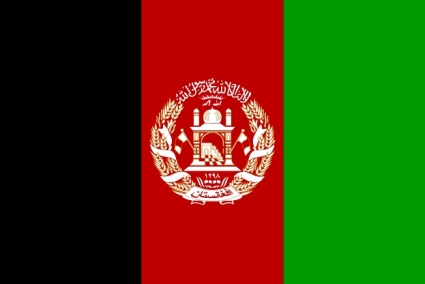
Afghan Army Raises Flag in Taliban Town

About one week ago an attack was launched on the Afghan town of Marjah.  Helicopter-borne U.S. Marines and Afghan troops swooped down on the Taliban-held town before dawn on Saturday, February 13, 2009, to re-establish government control and undermine support for the militants in their southern heartland.

On Wednesday, February 17, 2009, a Military commander raised the Afghan flag in the bullet-ridden main market of the Taliban’s southern stronghold of Marjah, signifying (to some) the end of the Taliban rule whilst elsewhere firefights continued to break out between holed-up militants and U.S. and Afghan troops.

Learn more here…

Soldier hoist an Afghan flag in Marjah, Afghanistan. Photo by Altaf Qadri.

February 18, 2010   No Comments